Say Less, Mean More: What Apple's Strategic Silences Teach You About Spoken English
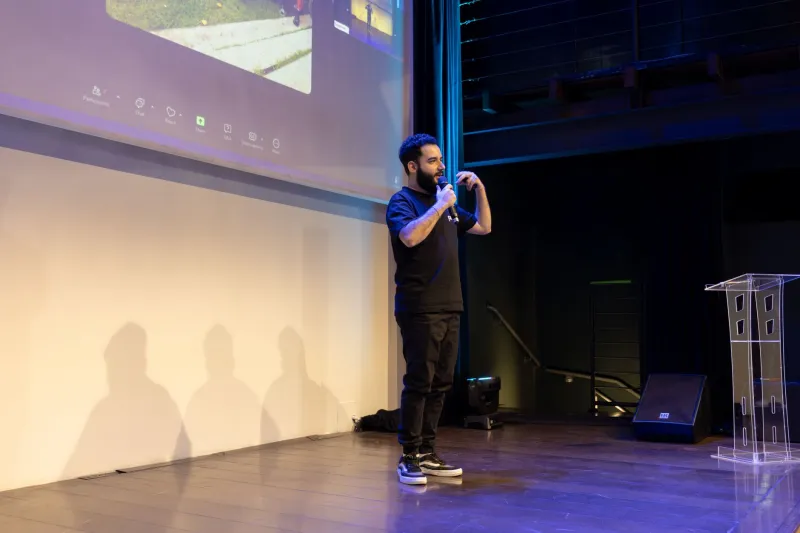
Watch a Tim Cook keynote carefully — not for what he says, but for what he doesn't. Between the product reveals and the polished statistics, there are these small, deliberate gaps. A beat. A breath. A moment where nothing happens, and somehow everything lands harder because of it.
For non-native English speakers, those silences can feel uncomfortable. In many cultures and languages, a pause in conversation signals confusion, hesitation, or even rudeness. So the instinct is to fill the space — with filler words, extra explanations, or a quick jump to the next sentence. But in professional American English, that instinct works against you.
The pause isn't empty. It's doing real work.
What's Actually Happening When Apple Executives Go Quiet
In a 2022 product event, Tim Cook introduced the new MacBook Pro lineup with a sentence that went something like this: "This... is the most powerful Mac laptop we have ever made." The ellipsis isn't in the script. It's a breath. A held moment. And it made that sentence feel like an event rather than a line of copy.
This is called a rhetorical pause — a silence used not because the speaker lost their train of thought, but because they know exactly what they're doing. It signals confidence. It tells the audience: I'm not rushing. I know what's coming, and so will you.
Former Apple design chief Jony Ive was famous for this in his product narration videos. Long pauses. Slow delivery. Words placed like objects on a shelf. The effect wasn't slow-wittedness — it was weight. Every word felt considered.
Why Native Speakers Use Silence as Punctuation
In written English, you have commas, periods, and em dashes to control pacing. In spoken English, pauses do the same job — and then some.
Here's how native speakers in professional settings typically use silence:
Before a key point: A brief pause before an important statement signals to the listener: pay attention now. It's the spoken equivalent of bold text.
After asking a question: Letting silence sit after a question — rather than immediately answering it yourself — creates space for the other person to think. It shows confidence in your question.
When you need a moment: Native speakers pause to think without saying "um" or "like." A clean pause sounds professional. A filler-word pause sounds uncertain.
To let something land: After delivering a punchline, a surprising statistic, or a strong opinion, pausing lets the idea settle. Rushing past it dilutes the impact.
The Filler Word Trap
Here's the challenge for many English learners: filler words feel safe. "Um," "uh," "like," "you know," "basically" — these are verbal crutches that buy time while your brain catches up. Every speaker uses them sometimes. But when they dominate your speech pattern, they send a subtle message to your listener: I'm not sure of myself.
Apple executives rarely use them in prepared remarks. And even in Q&A sessions — where answers aren't scripted — top communicators at companies like Apple, Google, and Microsoft tend to pause cleanly rather than fill the gap with noise.
The shift from "Um, so basically what I'm trying to say is..." to [pause] "What I mean is..." is small on paper. In a real conversation, it changes how people perceive you entirely.
A Simple Exercise to Build Your Pause Muscle
If you want to start using silence more deliberately in your own English, try this:
Record yourself giving a 60-second summary of something — a project update, a product you like, your opinion on a tech topic. Don't edit. Just talk.
Then play it back and count how many filler words appear. Now record it again, but this time, every time you feel the urge to say "um" or "like," just stop. Don't say anything. Let the silence exist.
It will feel strange. It will feel too long. Play it back anyway — it almost certainly won't sound as long as it felt, and it will sound significantly more confident.
Reading the Room: When Silence Means Something Different
One important cultural note: silence doesn't carry the same meaning in every context. In a fast-moving American tech team Slack call, a long pause might genuinely confuse people or make them think there's a connection issue. In a one-on-one meeting or a formal presentation, that same pause is power.
The key is learning to read the rhythm of the conversation you're in. Is this a quick brainstorm, or a moment of decision? Is your audience waiting for information, or processing something you've just said?
Apple keynotes are highly produced, and those pauses are often planned. But the underlying skill — knowing when to let silence work — is something you can develop in real, unscripted conversations too.
The Bottom Line
Language learning tends to focus on accumulation: more vocabulary, more grammar rules, more phrases to memorize. But professional English communication is also about subtraction — knowing what to leave out, when to stop, and how to let an idea breathe.
The next time you're in a meeting, a job interview, or a presentation, try treating silence the way Apple treats its product design: not as an absence, but as a deliberate choice. You might be surprised how much louder it speaks.